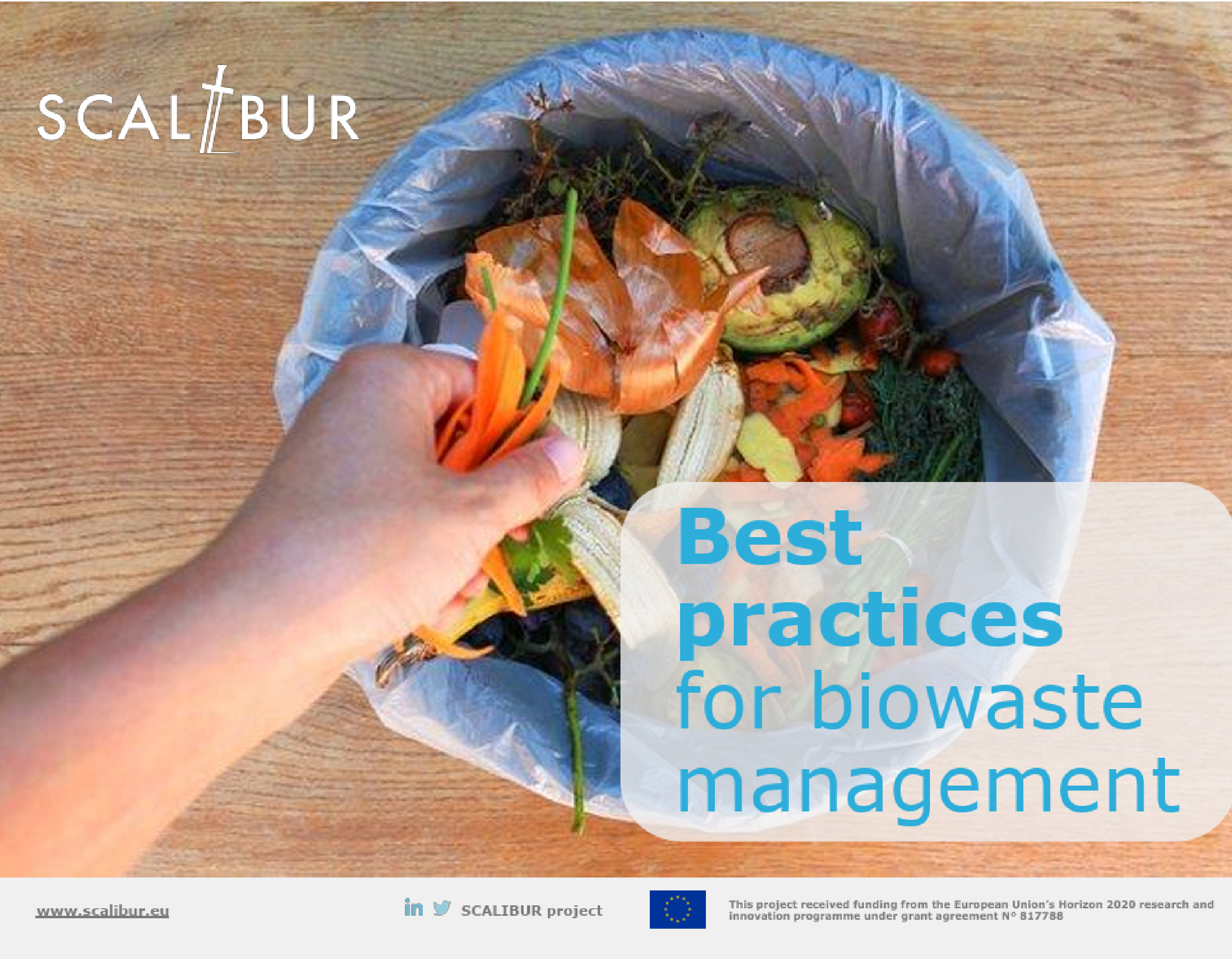
The SCALIBUR Best Practices factsheets compile practical measures to improve bio-waste management across the entire value chain, from collection to transport, awareness-raising, and characterisation. The document provides structured, replicable examples that municipalities and waste operators can adapt to local contexts.
In collection systems, the factsheets highlight solutions such as homogeneous bring banks, underground containers, chip-equipped bins to monitor filling levels, and biodegradable bags. They include targeted approaches for specific waste streams, such as HORECA establishments, open markets, and schools, as well as seasonal adjustments to maintain efficiency during peak periods. On-demand collection apps and ergonomic container design further enhance usability and participation.
For transport and logistics, the document promotes route-optimisation software, compacting trucks, electric vehicles, truck traceability systems, and eco-driving practices to reduce costs and environmental impacts.
Social awareness measures are presented as essential enablers of system performance. These include clear labelling, Pay-As-You-Throw schemes, school campaigns, public events, waste ambassadors, targeted communication, and transparent dissemination of environmental and economic benefits.
Finally, the factsheets emphasise characterisation and monitoring through systematic data collection and quality control of residual and separated waste streams. Together, these best practices provide an operational toolbox to increase efficiency, participation, and quality in bio-waste management systems.
Publication year: 2022
Language: EN
Published by: SCALIBUR
Keywords: bio-waste collection, OFMSW management, HORECA waste, route optimisation, waste logistics, pay-as-you-throw, PAYT, social awareness campaigns, waste characterisation, data monitoring, circular bioeconomy